Simple Battery in Florida: What the State Must Prove

A shove during an argument. A slap. Grabbing someone's arm. In Florida, any unwanted physical contact can result in a simple battery charge under F.S. 784.03 -- a first-degree misdemeanor carrying up to one year in jail. It's one of the most commonly charged crimes in Orange County, and it's also one of the most defensible.
Simple battery is the baseline battery offense in Florida. It sits below felony battery and aggravated assault on the severity scale, but a conviction still means a criminal record, potential jail time, and consequences that follow you for years.
What Is Simple Battery Under Florida Law?
Florida Statute 784.03 defines battery as either of two acts:
F.S. 784.03 -- Battery
A person commits battery if they:
- Actually and intentionally touch or strike another person against that person's will, OR
- Intentionally cause bodily harm to another person
Notice there are two separate paths to a battery conviction. The first -- unwanted touching -- doesn't require any injury at all. A push, a poke, even spitting on someone can qualify. The second path requires actual bodily harm, but the harm doesn't need to be severe.
The "Against Their Will" Requirement
This element is more important than most people realize. The State must prove the contact was unwanted. In mutual confrontations -- bar fights, heated arguments where both parties are pushing each other -- proving that the contact was truly "against the will" of the alleged victim becomes much harder for prosecutors.
What Must the State Prove?
To convict you, the prosecution must prove every element beyond a reasonable doubt:
Required Elements
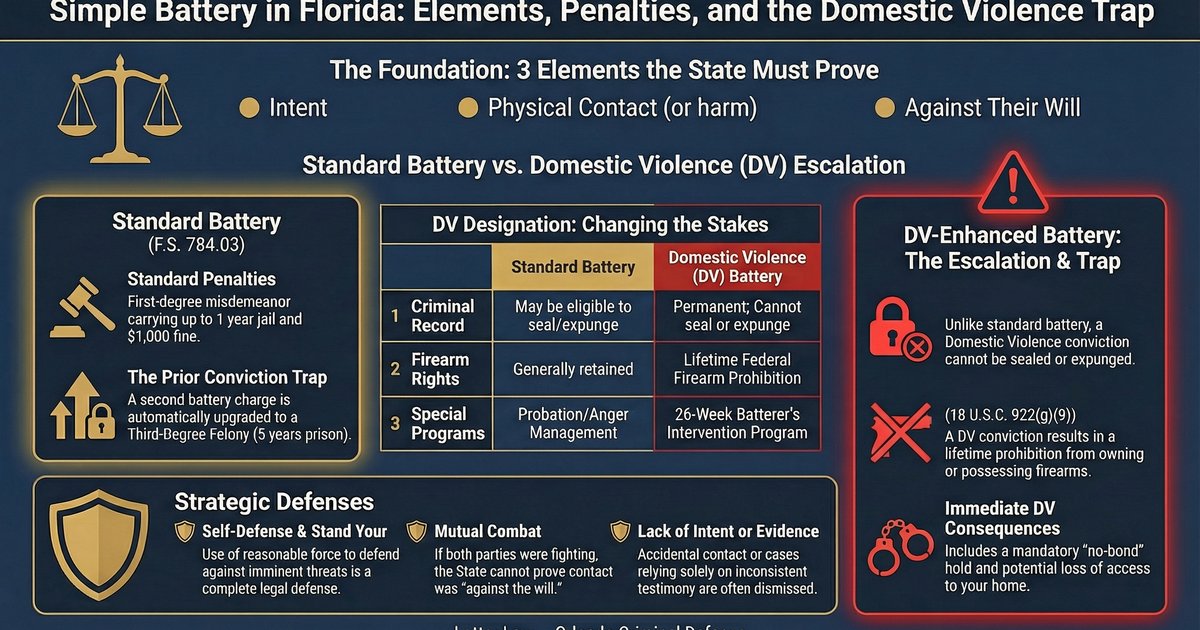
- Intent: You acted intentionally, not accidentally. Bumping into someone in a crowd isn't battery.
- Contact or Harm: There was actual physical contact (touching/striking) or actual bodily harm caused.
- Against Their Will: The contact was not consensual. If both parties were engaged in mutual combat, this element weakens significantly.
If any single element is missing, the charge should not stand. This is where experienced defense work makes the difference -- identifying which element the State can't actually prove.
Penalties for Simple Battery
Simple battery is classified as a first-degree misdemeanor in Florida. The maximum penalties are:
Maximum Penalties
- Up to 1 year in county jail
- Up to $1,000 in fines
- Up to 12 months of probation
- Permanent criminal record if convicted
In practice, most first-time simple battery cases don't result in jail time. Judges typically impose probation, community service, anger management classes, and a no-contact order. But those conditions come with their own risks -- any violation of probation can result in the full year of jail time.
The Domestic Violence Enhancement
This is where simple battery gets dangerous fast. If the alleged victim is a household or family member -- spouse, ex, someone you live with, co-parent -- the exact same charge becomes domestic violence battery under F.S. 741.28.
Why the DV Label Changes Everything
The charge is still a first-degree misdemeanor, but the consequences multiply:
- Mandatory no-contact order -- you may lose access to your own home
- No-bond hold until first appearance (typically 24 hours in jail minimum)
- Cannot seal or expunge -- a DV battery conviction stays on your record permanently
- Federal firearm prohibition -- under 18 U.S.C. 922(g)(9), a DV misdemeanor conviction bans you from ever owning or possessing a firearm
- 26-week Batterer's Intervention Program if convicted
- Immigration consequences -- DV convictions can trigger deportation proceedings
The federal gun ban alone makes domestic violence battery one of the most consequential misdemeanor charges in Florida. A simple shoving match between spouses can permanently strip your Second Amendment rights.
Defenses That Work
Self-Defense
Florida's self-defense laws apply fully to battery charges. If you used reasonable force to defend yourself from an imminent threat, you have a complete defense. Under Florida's Stand Your Ground statute (F.S. 776.012), you have no duty to retreat before using non-deadly force.
In practice, self-defense is the most common successful defense in battery cases. Officers responding to a disturbance often arrest one party based on limited information. By the time the case is fully investigated, witness statements, surveillance footage, or the alleged victim's own injuries may show that you were the one defending yourself.
Mutual Combat
When both parties are actively engaged in a physical confrontation, the "against their will" element becomes difficult for the State to prove. If the alleged victim was swinging back, pushing back, or escalating the confrontation, they weren't experiencing unwanted contact -- they were participating.
Lack of Intent
Battery requires intentional conduct. If the contact was genuinely accidental -- you tripped and fell into someone, you were gesturing and your hand made contact -- there's no battery. The State must prove you meant to make contact.
Insufficient Evidence
Many battery cases come down to one person's word against another. No witnesses. No video. No injuries. If the alleged victim's account is inconsistent, contradicted by the physical evidence, or lacking in detail, the State may not be able to meet their burden of proof.
The Recanting Victim Problem
In domestic cases, the alleged victim often wants to drop charges after the initial emotional response fades. But in Florida, the victim doesn't decide whether charges are pursued -- the State Attorney does. Even if the victim recants, the State may proceed if they believe they have enough evidence. However, a recanting victim makes the State's case significantly weaker, especially if there's no corroborating evidence like photos of injuries or independent witnesses.
When Simple Battery Becomes a Felony
Under F.S. 784.03(2), if you have a prior battery conviction -- any battery conviction, including a previous simple battery -- a second battery charge is automatically upgraded to a third-degree felony carrying up to 5 years in prison.
This is why resolving a first battery charge properly matters so much. A withhold of adjudication on the first case means it's not a "conviction" for purposes of this enhancement. Getting the right outcome the first time can prevent felony exposure down the road.
What to Expect After a Battery Arrest
The Timeline
- Arrest & booking: You'll be taken to the county jail for processing
- First appearance: Within 24 hours, a judge sets bond conditions (for DV cases, you'll have a mandatory no-contact order)
- Arraignment: Typically 2-4 weeks later, you enter a plea
- Pre-trial: Your attorney investigates, gathers evidence, negotiates with the State
- Resolution: Case resolves through dismissal, plea negotiation, or trial
The most critical window is the first 48 hours. Statements you make to police, text messages you send after the incident, and social media posts can all become evidence. The single best thing you can do after a battery arrest is stop talking about the case with anyone except your attorney.
Facing Battery Charges in Orlando?
Simple battery is one of the most defensible charges in Florida -- but only if the defense starts early. As a former law enforcement officer, I know how officers investigate these cases, where their reports tend to be incomplete, and what evidence matters most.
Call 407-500-7000 for a free consultation. We'll review the facts of your case and identify the strongest path forward.
Call Now - Free Consultation