Possession With Intent to Sell in Florida: Where the Line Is
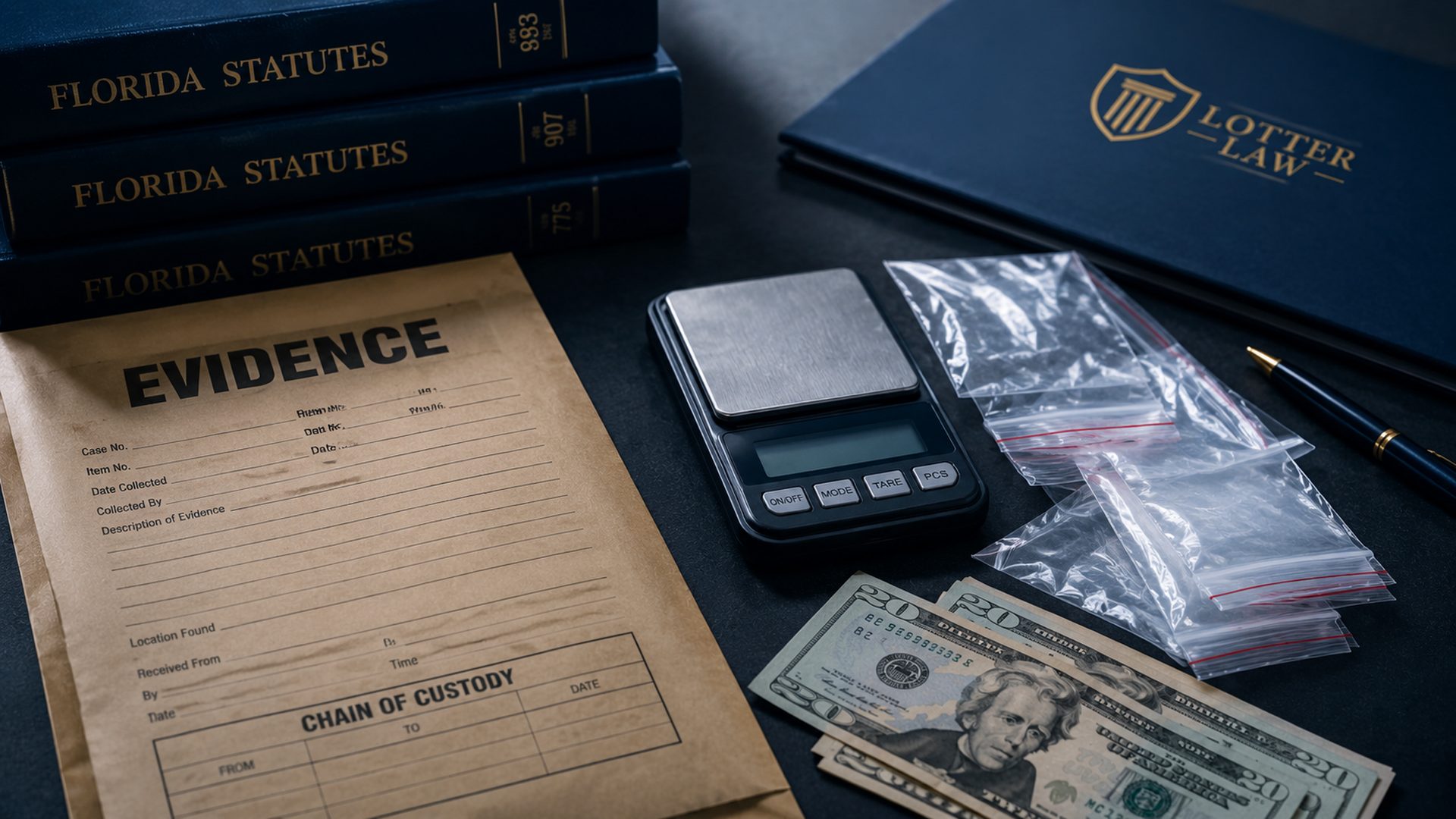
Two people are caught with the exact same amount of the exact same drug. One is charged with simple possession. The other is charged with possession with intent to sell -- a far more serious felony. The drugs didn't change. What changed is everything around them: the packaging, the cash, a scale, a few text messages. In Florida, that's often the whole difference between a manageable case and a prison-exposure case.
Here's how the line works under Florida law, why the "intent" piece is usually circumstantial, and how these charges are defended.
The Charge and How It's Graded
Under F.S. 893.13(1)(a), it's a crime to "sell, manufacture, or deliver, or possess with intent to sell, manufacture, or deliver, a controlled substance." The felony level depends on the drug's schedule:
Possession With Intent (F.S. 893.13(1)(a))
- Schedule I or II (cocaine, heroin, meth, oxycodone, most "hard" drugs): second-degree felony -- up to 15 years.
- Schedule III, IV, or V: third-degree felony -- up to 5 years.
Compare that to simple possession under F.S. 893.13(6): generally a third-degree felony, but possession of 20 grams or less of cannabis is only a first-degree misdemeanor. Adding the words "with intent to sell" can move the same conduct up several rungs -- which is exactly why how the State proves intent matters so much.
The "Intent to Sell" Leap
Prosecutors rarely have a video of a sale. Instead, they ask a jury to infer intent from the surrounding circumstances. The classic "indicia of sale" the State points to:
- Quantity larger than a typical personal-use amount
- Packaging -- multiple small baggies or individually portioned doses
- A digital scale or measuring tools
- Cash, especially in small denominations
- Multiple phones, "ledgers," or sale-related text messages
- Absence of use paraphernalia (no pipe, no needle -- "so it must be for selling")
Inference Is Not Proof
Every one of those "indicators" has an innocent explanation. People who use drugs often buy in bulk to save money, keep cash for ordinary reasons, and own scales or phones for entirely lawful purposes. An inference of intent built on a stack of maybes is exactly the kind of case a defense attorney attacks -- because the State still has to prove intent beyond a reasonable doubt.
Is There a "Magic Number"?
Below the trafficking weights, Florida law sets no bright-line quantity that automatically proves intent to sell. It's a totality of the circumstances question for the jury. That cuts both ways: a relatively small amount split into ten individual baggies can be charged as intent to sell, while a larger single stash with a pipe next to it may look like personal use. The drugs alone rarely decide it -- the story the State builds around them does.
It also means timing and context matter. Most of these cases don't start with a controlled buy; they start with a traffic stop, a "consent" search, or a search warrant -- and what officers say they saw and smelled becomes the foundation for everything that follows. If that foundation is shaky, so is the intent charge built on top of it.
Don't Confuse It With Trafficking
People often use "trafficking" loosely, but it's a separate, even more serious charge under F.S. 893.135 -- and it's based on weight, not intent. Once the amount crosses a statutory threshold, trafficking applies even if there was never any intent to sell, and it carries mandatory-minimum prison terms and large fines. That's why the weight the State attributes to you -- including questions about mixtures and packaging -- can be decisive.
The 1,000-Foot Enhancement
Where the alleged sale happened can raise the stakes again. Under F.S. 893.13(1)(c)-(h), selling or possessing with intent within 1,000 feet of a school, college, park, church, public housing, convenience store, or treatment facility bumps the offense level -- and for Schedule I/II drugs, it can become a first-degree felony with a 3-year mandatory minimum. In a dense area like Orlando, that radius covers a lot of ground.
How These Cases Are Defended
Where the Defense Lives
- Attack the intent inference. Reframe the "indicia of sale" as consistent with personal use -- no observed sale, no buyer, no marked-money buy.
- Challenge the search. If the stop, search, or warrant was unlawful, the drugs may be suppressed. The reason police got into the car or home is often the whole case -- see when odor alone justifies a search.
- Question possession itself. Drugs found in a shared car or home raise constructive possession problems -- the State must tie them to you, with knowledge and control.
- Test the substance and the weight. Lab analysis, chain of custody, and how the weight was measured all matter -- especially near a trafficking threshold.
Bottom Line
In a Florida drug case, the substance is only part of the story. "Intent to sell" is usually built from circumstantial pieces -- and those pieces can be pulled apart. Whether a charge stays simple possession, climbs to intent-to-sell, or gets pushed toward trafficking often turns on the evidence the State infers from, and on how the drugs were found in the first place.
Facing a Drug Charge in Orlando?
"Intent to sell" and "trafficking" are not foregone conclusions. We challenge the search, the inference of intent, and the weight -- to keep a case from becoming worse than the facts justify. Call now for a free, confidential consultation.
Free Consultation: 407-500-7000Related Articles
Drugs in the Car? Felony Dismissed
When drugs are found in a shared space, the State has to prove they were yours.
Marijuana Smell & Vehicle Search Rights in Florida
When odor alone can -- and can't -- justify a search of your car.
Container Weight Can't Be Counted in Florida Drug Charges
How weight is measured can push a case toward -- or away from -- trafficking.
Drug Paraphernalia Charges in Florida: Defenses
The scales, baggies, and pipes the State leans on -- and how they're challenged.