License Plate Frames in Florida: What's Legal Under the New Law
FLHSMV Just Clarified F.S. 320.262 - Here's What You Need to Know
Published on by Attorney Jeff Lotter
Got pulled over for an "obscured" license plate? You're not alone. Florida's new license plate law has officers writing tickets for plate frames that have been on cars for years. But the law may not say what they think it says.
The New Law: F.S. 320.262
On October 1, 2025, Florida Statute 320.262 went into effect. The law prohibits "license plate obscuring devices" and creates criminal penalties ranging from a second-degree misdemeanor to a third-degree felony.
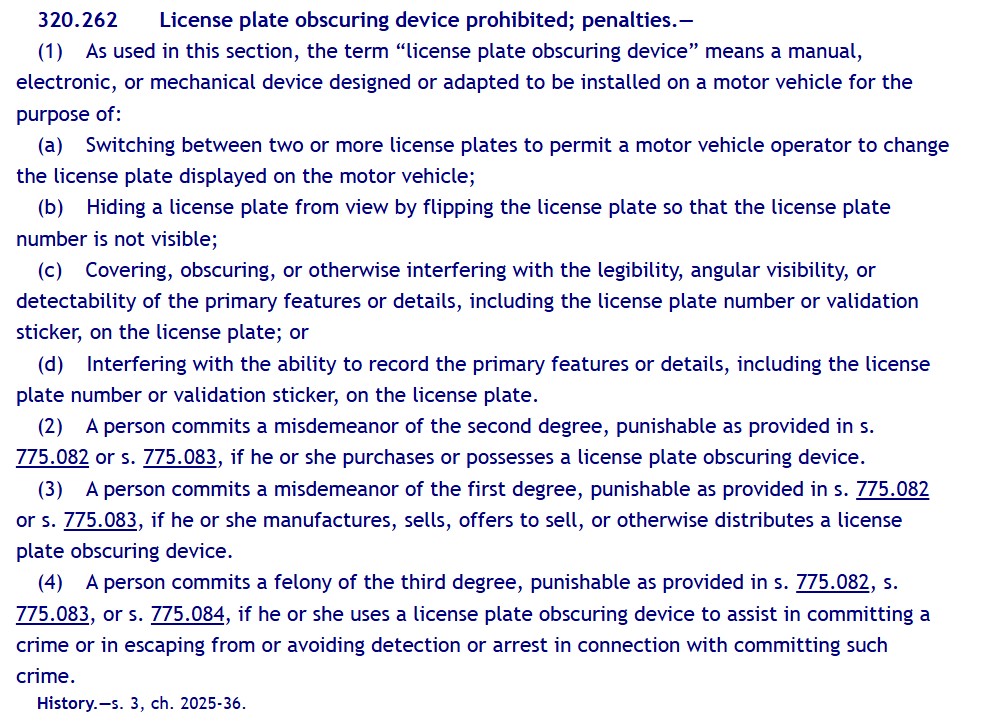
The Full Statute Text
320.262 License plate obscuring device prohibited; penalties.—
(1) As used in this section, the term "license plate obscuring device" means a manual, electronic, or mechanical device designed or adapted to be installed on a motor vehicle for the purpose of:
(a) Switching between two or more license plates to permit a motor vehicle operator to change the license plate displayed on the motor vehicle;
(b) Hiding a license plate from view by flipping the license plate so that the license plate number is not visible;
(c) Covering, obscuring, or otherwise interfering with the legibility, angular visibility, or detectability of the primary features or details, including the license plate number or validation sticker, on the license plate; or
(d) Interfering with the ability to record the primary features or details, including the license plate number or validation sticker, on the license plate.
(2) A person commits a misdemeanor of the second degree, punishable as provided in s. 775.082 or s. 775.083, if he or she purchases or possesses a license plate obscuring device.
(3) A person commits a misdemeanor of the first degree, punishable as provided in s. 775.082 or s. 775.083, if he or she manufactures, sells, offers to sell, or otherwise distributes a license plate obscuring device.
(4) A person commits a felony of the third degree, punishable as provided in s. 775.082, s. 775.083, or s. 775.084, if he or she uses a license plate obscuring device to assist in committing a crime or in escaping from or avoiding detection or arrest in connection with committing such crime.
History.—s. 3, ch. 2025-36.
The Problem: Broad Language
Read that statute carefully. Section (1)(c) prohibits devices that cover or obscure "primary features or details" of the plate. But what are "primary features"? The statute doesn't define them. This vague language allows for extremely broad interpretation.
The Broad Interpretation Problem
Some officers have interpreted this statute to mean any frame that touches any part of the plate is illegal. Under this reading, the dealership frame that came with your car—the one that's been there for years—suddenly makes you a criminal. That interpretation is wrong, and the agency that regulates Florida plates has now confirmed it.
Got a ticket for an "obscured" license plate?
If your plate frame is legal under FLHSMV guidance, you may have grounds to fight the citation. Don't pay the ticket without understanding your options.
Free Consultation: 407-500-7000Here's the key: the statute targets devices "designed or adapted" for the purpose of obscuring plates. A decorative frame isn't designed to obscure anything—it's designed to hold or decorate the plate. That's a critical distinction.
FLHSMV Narrows the Scope
The statute's broad language created confusion across Florida. Officers started writing tickets for standard plate frames, interpreting "primary features" to mean everything on the plate. That changed on December 12, 2025.
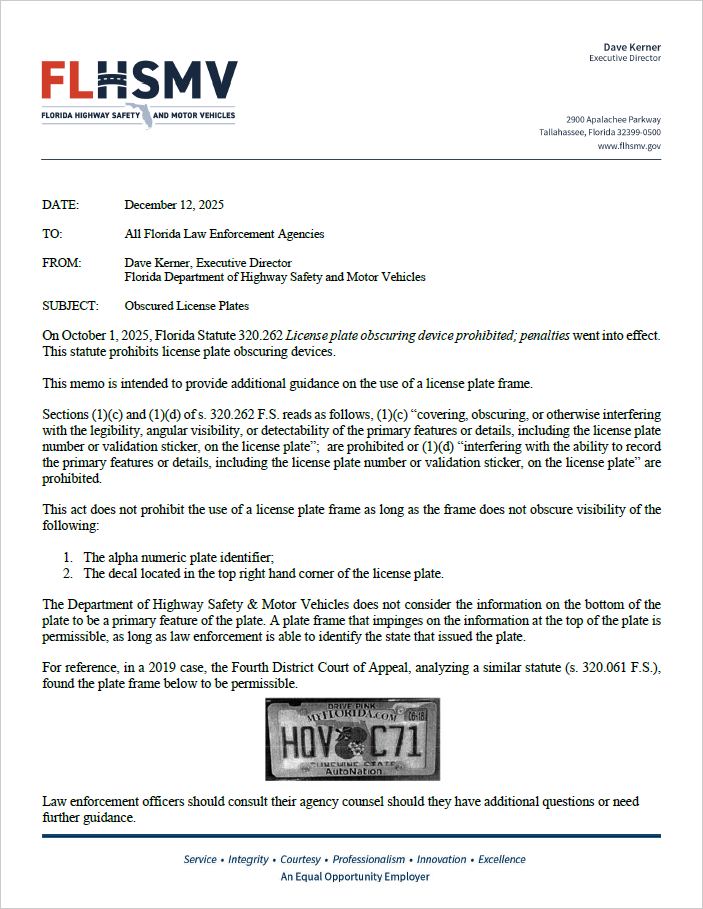
The Florida Department of Highway Safety and Motor Vehicles (FLHSMV)—the agency that issues Florida plates and has authority over vehicle registration—issued official guidance to all Florida law enforcement agencies. This memo significantly narrows the statute's scope.
FLHSMV Defines "Primary Features"
The memo states that frames ARE allowed as long as they don't obscure:
- The alpha numeric plate identifier (the actual plate number)
- The decal located in the top right hand corner (registration sticker)
That's it. Two things. Not "Sunshine State." Not "myFlorida.com." Just the plate number and the decal.
The Bottom of the Plate Is NOT a Primary Feature
This is the critical clarification that many officers don't know:
"The Department of Highway Safety & Motor Vehicles does not consider the information on the bottom of the plate to be a primary feature of the plate."
— FLHSMV Memo to Law Enforcement, December 12, 2025
The statute says you can't obscure "primary features." The FLHSMV—the agency with authority over Florida plates—has now defined what that means. A frame that covers "Sunshine State" at the bottom? Legal. A dealership frame that covers "myFlorida.com"? Legal.
The memo explicitly states that covering bottom information is "permissible, as long as law enforcement is able to identify the state that issued the plate." The "FLORIDA" text at the top of the plate accomplishes that.
Why This Matters
The FLHSMV memo is significant for two reasons:
1. Agency Interpretation Controls
When a statute is ambiguous, courts give deference to the agency responsible for enforcing it. The FLHSMV is that agency for license plate regulations. Their interpretation of "primary features" carries weight.
2. Officers Were Notified
This memo was sent to "All Florida Law Enforcement Agencies." If an officer writes you a ticket for a frame that only covers the bottom of your plate, they're acting contrary to the guidance from the agency that regulates plates.
What IS Illegal
The statute does prohibit certain plate modifications. You cannot:
Tinted Plate Covers
Plastic covers that darken, tint, or reduce the visibility of the plate—especially from angles or under certain lighting—are prohibited.
Covers That Block Camera Detection
Any device designed to interfere with toll cameras, red light cameras, or license plate readers is illegal under the new law.
Frames Covering the Plate Number
If your frame actually covers any part of the alphanumeric plate identifier, that's a violation.
Frames Covering the Registration Decal
The decal in the top right corner showing your registration expiration must be fully visible.
Case Law Supports This Interpretation
The FLHSMV memo references a 2019 case from Florida's Fourth District Court of Appeal analyzing a similar statute (F.S. 320.061). The court found that a standard dealership-style plate frame—the kind that says "AutoNation" at the bottom—was permissible.
What This Means for Your Case
If you received a ticket for a frame that only covers the bottom of your plate (like "Sunshine State" or a dealership name), you have strong grounds to contest it. The FLHSMV—the agency that issues Florida plates—has explicitly stated this is not a violation.
Got a Ticket for an "Obscured" Plate?
If you've received a citation under F.S. 320.262, here's what you should know:
1. Document Your Plate
Take clear photos of your license plate with the frame attached. Show that the plate number and registration decal are fully visible.
2. Don't Just Pay the Ticket
Paying the fine is an admission of guilt. If your frame is legal under FLHSMV guidance, you may be able to get the ticket dismissed.
3. Request the Officer's Training Records
The FLHSMV memo was sent to all law enforcement agencies. If the officer wasn't aware of this guidance, that's relevant to your defense.
4. Consider the Real Reason for the Stop
"Obscured plate" has become a common pretext for traffic stops. If the officer was really looking for something else—and your plate was legal—the entire stop may be questionable.
Points and Insurance
While F.S. 320.262 is a non-moving violation (no points), paying the ticket still creates a conviction on your record. This can affect insurance rates and shows up on background checks.
Frequently Asked Questions
Can I use a dealership frame?
Yes. Standard dealership frames that only cover the bottom portion of the plate ("AutoNation," "Holler Honda," etc.) are legal as long as the plate number and registration decal are visible.
What about chrome or decorative frames?
Legal, as long as they don't cover the alphanumeric identifier or registration decal. The material and style don't matter—only what's covered.
Are tinted plate covers illegal?
Yes. Any cover that reduces visibility or readability of the plate—especially tinted plastic covers—is prohibited under the new law.
What if my frame covers "Sunshine State"?
That's legal. The FLHSMV explicitly states that the bottom text is not a "primary feature" of the plate.
Can officers still use this as a reason to stop me?
Officers can stop you if they reasonably believe the plate is obscured. But if your frame is actually legal under FLHSMV guidance, the resulting ticket should be dismissed—and any evidence from the stop may be challenged.
Got a Traffic Citation?
Even minor traffic violations can lead to bigger legal problems. Protect your record with experienced representation.
Learn About Traffic Defense →Related Articles
Cited for an Obscured License Plate?
Don't pay the ticket without understanding your options. If your plate frame is legal under FLHSMV guidance, you may be able to get the citation dismissed.
Free Consultation | Traffic Ticket Defense | Results-Focused Representation
Law Office of Jeff Lotter PLLC
Serving Orlando, Orange County, and Central Florida